
State of Vector Databases Q2 2026


Summary
- The vector database market is fragmenting by scale, workload, and deployment rather than disappearing.
- Postgres can handle many smaller vector workloads, while purpose-built engines remain stronger at larger scales.
- Agentic AI is shifting retrieval toward write-heavy, low-latency, and hybrid memory patterns.
- Pinecone Nexus shows how vendors are moving beyond basic RAG, but its performance claims still need independent validation.
- The key decision is matching the retrieval architecture to the workload instead of treating every AI use case the same.
Qdrant’s 2026 momentum shows the vector database market is fragmenting rather than disappearing.
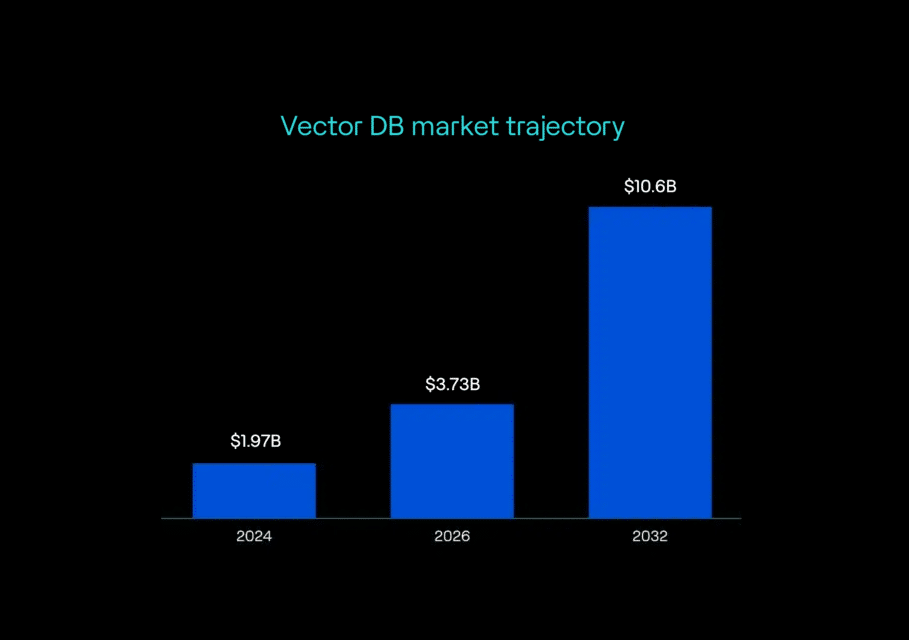
In 2025, Elastic’s CEO Ashutosh Kulkarni declared that “Vector databases are a feature. They are never going to be a business in and of themselves.” On March 12th 2026, Qdrant raised $50M Series B, crossed 250 million downloads, and shipped version 1.17. By June 2026, the project reached 32,400 GitHub stars, up from 27,000 in December 2025. Research and Markets projects the vector database market will grow from $3.73B in 2026 to $10.6B by 2032 at a 23.5% CAGR. A dying category does not produce those numbers.
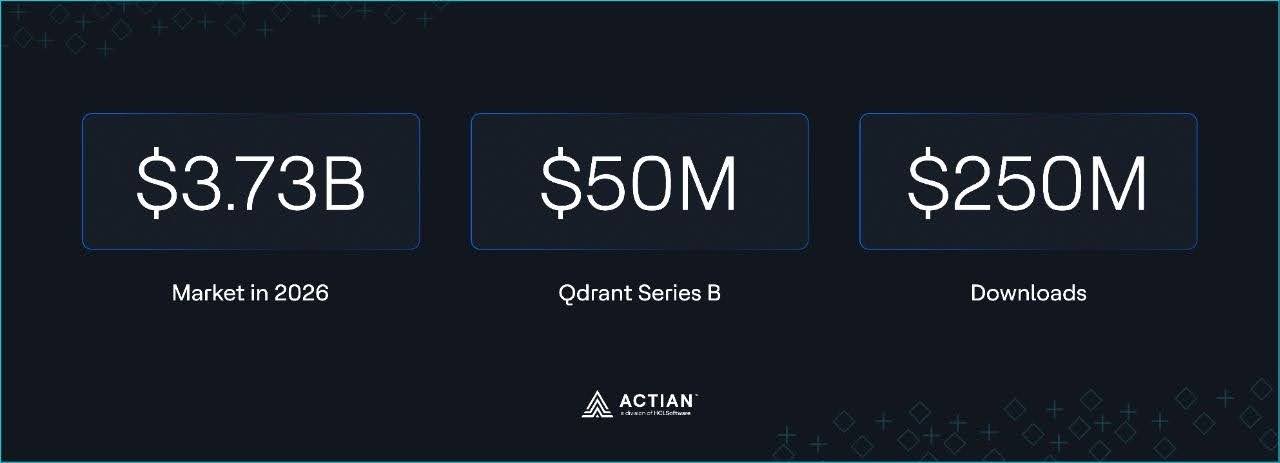
Qdrant growth snapshot
Ashutosh described real commodity pressure, but only for a part of the market. PostgreSQL with pgvector now absorbs workloads under 50M vectors and reduces total cost of ownership (TCO) by 40–60%. Hierarchical Navigable Small World (HNSW) and Inverted File Flat (IVFFlat) indexes enable Approximate Nearest Neighbor (ANN) search, while PostgreSQL maintains ACID compliance that native vector databases do not offer. Combining keyword search and in-database vector similarity within a single system eliminates the need for a separate vector store. That is the market segment Ashutosh’s argument accurately captures.
Above 50M vectors, the performance gaps become visible. pgvector stores embeddings directly inside PostgreSQL tables. A dataset with 1M (1,536-dim) vectors consumes roughly 6 GB for the vectors alone, with HNSW indexing adding another 3–4 GB at default settings. Index build time increases with each new workload, and latency climbs from 50ms to 800ms past the 10M-embeddings mark on a 1TB RAM instance.
Billion-scale workloads expose what relational databases cannot sustain without continuous reconfiguration, quantization, and on-disk indexing. TripAdvisor indexes 1B+ multimodal user reviews on Qdrant. HubSpot runs Qdrant for its Breeze AI assistant. A general-purpose database with a vector data type struggles at that scale.
The death narrative and the vector database category growth are valid in Q2 2026, but they define different parts of the same market. Where you sit on the scale, workload, and deployment spectrum determines which argument applies to your infrastructure decisions this quarter.
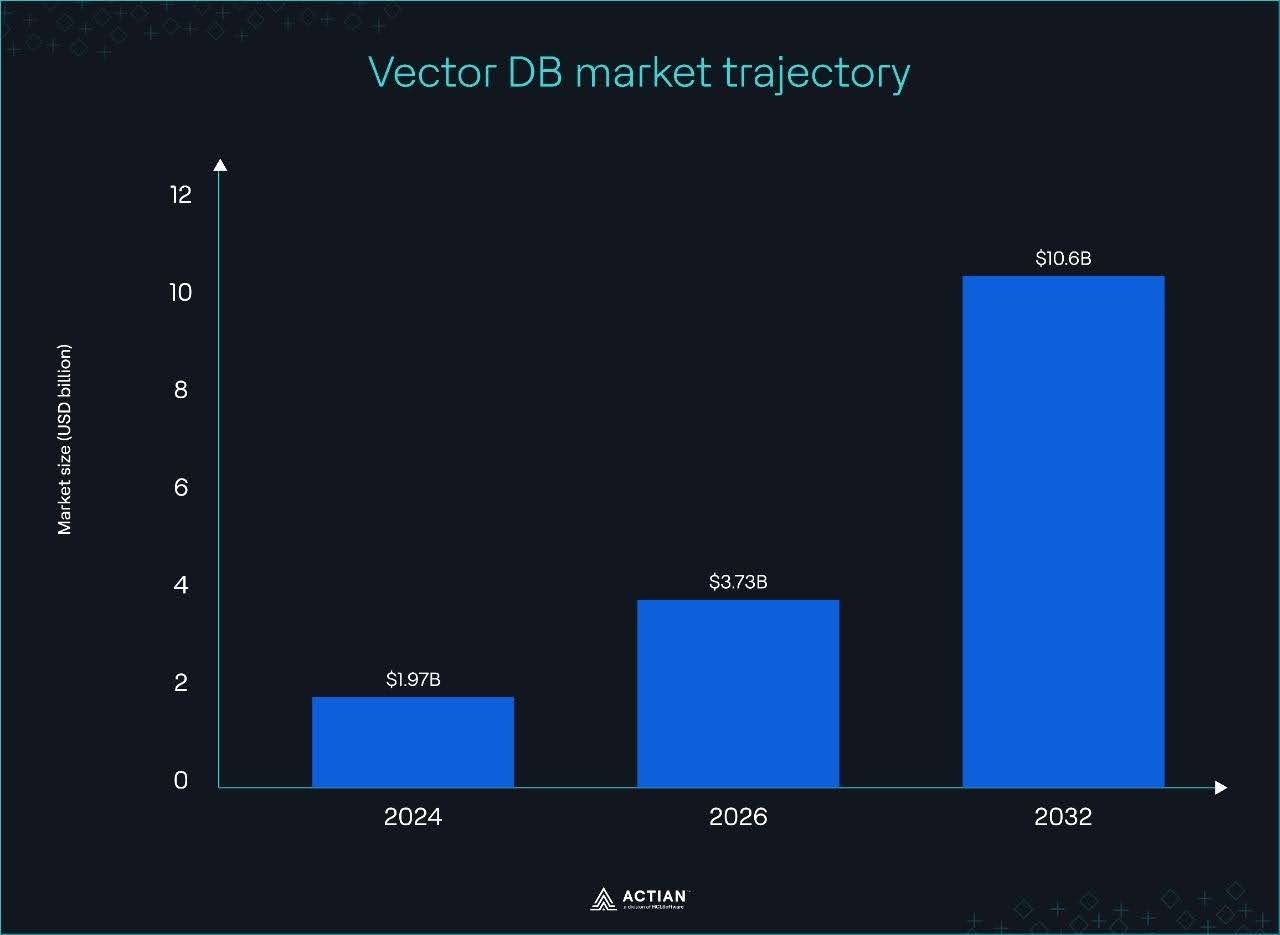
The vector DB market is growing. The question is which segment each vendor can serve.
The Trifurcation Thesis: One Market Splitting into Three
The vector database market is not collapsing to a single winner. There are three simultaneous splits across scale, workload type, and deployment environment. Most architectural decisions in 2026 are getting the wrong answer because teams are only evaluating vector count.
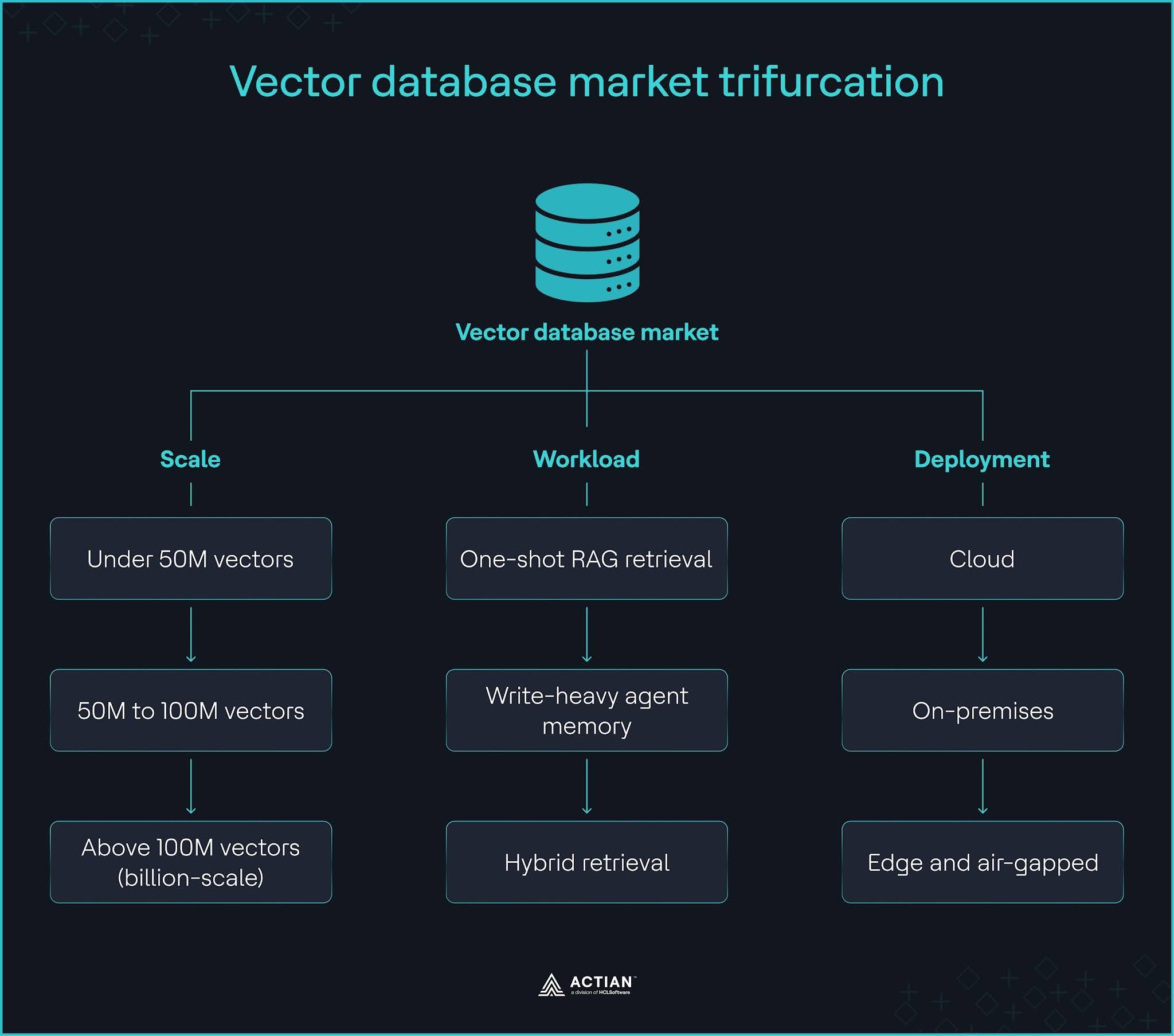
Vector database market trifurcation across scale, workload, and deployment
Scale: Where Postgres wins and where it stops
Every major cloud hyperscaler and traditional relational database now ships pure vector search. PostgreSQL has pgvector and pgvectorscale, Oracle has Database 26ai, Microsoft SQL Server added a vector data type, Amazon RDS uses pgvector, and Google’s Cloud SQL for MySQL has similarity search. Stack Overflow’s annual Developer Surveys show PostgreSQL held the top database position from 2023 to 2025.
Below 50M vectors, Postgres with pgvector and pgvectorscale supports production workloads without requiring a separate vector engine. For teams already on Postgres, adding vector search with pgvector is one CREATE EXTENSION vector; command. TigerData benchmarked pgvectorscale against Qdrant on the Cohere Wikipedia 50M (768-dim) dataset, targeting 99% recall on an AWS r6id.4xlarge instance. pgvectorscale returned 471.57 queries per second (QPS) against Qdrant’s 41.47 QPS, an 11x throughput difference on a single-node configuration.
Postgres won on throughput, but Qdrant won on p95 latency at 36.73ms against pgvectorscale’s 60.42ms, and index build time at 3.3 hours against 11.1 hours. As Desmond Tan, our vice president of engineering, puts it,
At a billion-vector scale and under strict latency budgets, a general-purpose database bolting on a vector type does not hold up. The hard part was never nearest-neighbor search. It is the operational envelope, like recall stability under continuous updates.
Purpose-built engines increase index build speed, handle sharding across nodes, manage disk offloading, and maintain predictable p95 latency under concurrent writes that 100M+ vector workloads demand. NVIDIA built a multimodal data mining system on Milvus, indexing 10B+ sensor data points from test fleets, and achieved a 30x cost reduction without architectural redesign. When you are tuning autovacuum and maintenance_work_mem to hold recall steady, your workload has moved past Postgres with pgvector.
Workload: AI agents broke the read-optimized assumption
Dedicated vector databases were built for read-heavy Retrieval-Augmented Generation (RAG) pipelines. In 2026, AI agents issue 10x more queries than humans. They write frequently and create index bloat, traffic spikes, and multi-tenancy pressure that read-optimized indexes do not handle well. As one eToro backend engineer posted on X,
The 2026 question is no longer which vector database to pick. It is which retrieval strategy the workload actually needs. Most production failures come from forcing every problem into the same simple retrieve-then-generate pipeline.
Cloud-first vector databases are responding to write-heavy workloads with auto-scaling, native row-level isolation, and real-time streaming. But the market is also rethinking whether the database should live in the cloud at all.
Deployment: The axis cloud-native vendors cannot address
For industries handling sensitive data, vector embeddings must meet stringent compliance standards under laws like the EU AI Act, US CLOUD Act, General Data Protection Regulation (GDPR), and Health Insurance Portability and Accountability Act (HIPAA). Gartner predicts that by 2030, more than 75% of European and Middle Eastern enterprises will repatriate their virtual workloads due to geopolitical risk, up from less than 5% in 2025. Cloud vendors provide compliance certificates, but keeping the database on-premises gives teams direct control over data governance and reduces the single points of failure that cloud infrastructure introduces.
The right infrastructure in Q2 2026 depends on your vector count, operational fit, and deployment constraints. This table shows you how to decide.
| Dimension | Use pgvector if | Use a purpose-built vector engine if |
| Vector count | < 50M vectors | > 50M vectors |
| Filtering complexity | Simple; PostgreSQL handles WHERE clauses and hybrid search with BM25 + dense vectors | Medium; payload, scalar, or metadata filtering with nested conditions |
| Multi-tenancy requirements | Schema-per-tenant; you build and enforce the isolation layer | Strict per-tenant isolation via namespaces, partitions, or collections |
| Deployment constraint | Existing PostgreSQL engine, on-premises | Managed SaaS, self-hosted Kubernetes or Docker |
| Operational complexity tolerance | Low; team has Postgres expertise | Low to high, depending on deployment constraints; managed operations for cloud-based engines; DevOps expertise for self-hosted vector databases |
Pinecone: The Paradox of the Quarter
Pinecone is positioning Nexus as the agentic architecture that replaces RAG, backed by a single internal benchmark no one has reproduced. That unverified test, not the launch itself, is what determines whether Nexus belongs in your agent infrastructure this quarter.
Pinecone’s revenue dropped from $27M in 2024 to $14M in 2025, Notion churned, and The Information reported the company was exploring a sale in August 2025. Nine months later, on May 4th, 2026, they shipped Nexus, their most ambitious product launch yet. If you’re running vector workloads on Pinecone, that sequence is the context you evaluate Nexus against.
Nexus is Pinecone’s attempt to move up the agentic AI stack. It combines a context compiler that produces task-specific vector artifacts from raw vector database information, and a composable retriever that serves those artifacts with per-field citations and deterministic conflict resolution. Pinecone CEO Ash Ashutosh called the launch an architectural shift:
RAG was built for human users. Nexus was built for agentic users because their language is very different.
KnowQL, a declarative query language, followed the Nexus release. It enables AI agents to specify intent, provenance, output shape, latency budgets, and confidence requirements without interpreting raw vectors directly. Pinecone’s Nexus internal benchmark on SEC 10-K filings reported completion rates rising from 50–60% to above 90%, a 95% reduction in Large Language Model (LLM) token usage, and a 30x increase in task execution speed. None of these results have been validated in production deployments.
Nexus’s mechanism of compiling reasoning once before any query runs and storing the results as reusable artifacts is directionally sound. Gartner’s VP Analyst Arun Chandrasekaran described it as a meaningful step beyond simple retrieval: “Unlike traditional RAG, which relies on pure semantic search at runtime, architectural compilation embeds structural logic into the metadata layer, which can boost time to response and provide better reasoning.” Janakiram MSV pushes back on KnowQL specifically, arguing that “KnowQL has to clear the standardization bar SQL cleared, and standards do not get declared into existence by a single vendor.”
Desmond agrees the Nexus principle is sound but not new, calling it “caching applied to retrieval.” On the single-test-case benchmark, he’s direct: “Before recommending Nexus, I would need independent reproduction on a non-cherry-picked suite, a clear account of the stale-artifact failure mode, and an honest reckoning of lock-in.” He would not commit agent infrastructure to it this quarter because “KnowQL is a single-vendor query language and SQL became a standard by committee, not by declaration.”
Pinecone claims its vector engine serves 9,000 customers and 800,000 developers. The company pioneered the managed vector database category in 2023 and reached $750M in valuation after a $100M Series B. They built their founding message on RAG, then launched Nexus as the product that moves beyond it. But Nexus still depends on Pinecone’s vector database for retrieval speed, storage, and scale. Ash confirmed that “the vectors are still stored and managed by the Pinecone vector database.” The market claim that RAG-era infrastructure is obsolete does not hold when agentic systems still live on it.
The sale report remains unconfirmed, and the benchmark gains are unvalidated. But your embedding pipeline is what you control, regardless of what happens next. Document the model, version, dimensions, and chunking strategy today. Keep your retrieval substrate portable so a compilation layer remains an optional optimization you can replace.
Are Vector Databases the Right Substrate for Agent Memory?
Vector databases handle one category of agent memory well, and degrade on the other. Forcing one index type to serve different retrieval needs is how most production AI architectures fail.
Agent memory runs two distinct workloads. One-shot semantic retrieval over a stable document library is read-heavy and batch-indexed. That is RAG, and HNSW and IVF indexes handle it well. The second part is the working agent memory. It involves frequent writes, iterative retrieval, fact extraction, and entity resolution. A read-optimized index degrades under this workload.
Hindsight’s Ben Bartholomew was partially right when he said, “‘Agent memory means vector database’ has become a kind of folk wisdom… Agent memory is something else, and treating the two as the same problem is what produced the bad default in the first place.” The table below maps how RAG and agent query patterns differ across five retrieval dimensions.
| Criteria | RAG query pattern | Agent query pattern |
| Access pattern | Read-heavy | Read/write |
| Retrieval style | One-shot | Iterative |
| Latency budget | >500ms | Sub-200ms per tool call |
| Freshness requirement | Batch indexing | Streaming |
| Index type | HNSW/IVF | Write-optimized or hybrid |
Anthropic removed vector search from Claude Code in May 2025 and replaced it with grep. Cursor, Windsurf, Cline, Devin, and Sourcegraph Amp followed this pattern, dropping vector similarity for tool-driven search.
Weaviate’s product team spent two weeks integrating Engram, their vector-backed memory product, with Claude Code via Model Context Protocol (MCP). Claude ignored it entirely, explaining, “I default to MEMORY.md because it’s always loaded: zero latency, zero tool calls, guaranteed in context. There’s no reason to reach for an external tool when the primary memory store is already present.” A coding agent traverses a graph of dependencies, imports, function calls, and type definitions. That workload demands determinism and exact matches, rather than semantic similarity.
The Hindsight team uses a multi-strategy approach that merges and ranks four parallel retrievers on PostgreSQL: semantic search, entity-based retrieval, temporal filtering, and graph traversal. On the LongMemEval benchmark, this hybrid approach achieved 94.6% accuracy against Mem0’s vector-primary system’s 49%. grep and hybrid retrieval deliver better results than pure vector search for coding agents and frequently updated document collections under 10M. Keeping a vector index synchronized with an active codebase requires frequent re-embedding, which is costly at scale and delays retrieval freshness.
Hindsight’s argument is that a vector database lacks the temporal awareness, separation of concerns, and conflict-resolution capabilities that working agent memory demands. The problem is applying vector search to the wrong agent constraint.
&AI CTO Herbie Turner confirmed that Qdrant is “the ground truth” for their patent agent handling over one billion vectors. Reddit still runs billion-scale vector data on Milvus. AI memory frameworks like Mem0 use vector databases as the underlying retrieval infrastructure, paired with a knowledge graph for entity relationships. Vector databases hold long-term domain facts across sessions. For large, heterogeneous knowledge bases where retrieval accuracy drives business outcomes and missed results are expensive, vector search remains the right approach. It is also the practical retrieval strategy for natural-language queries in unstructured document search systems.
Qdrant CEO Andre Zayarni explained the query volume gap that makes vector databases relevant:
Humans make a few queries every few minutes. Agents make hundreds or even thousands of queries per second, just gathering information to be able to make decisions.
Agents waste up to 85% of compute on context recovery. Vector databases make that recall fast and accurate at scale.
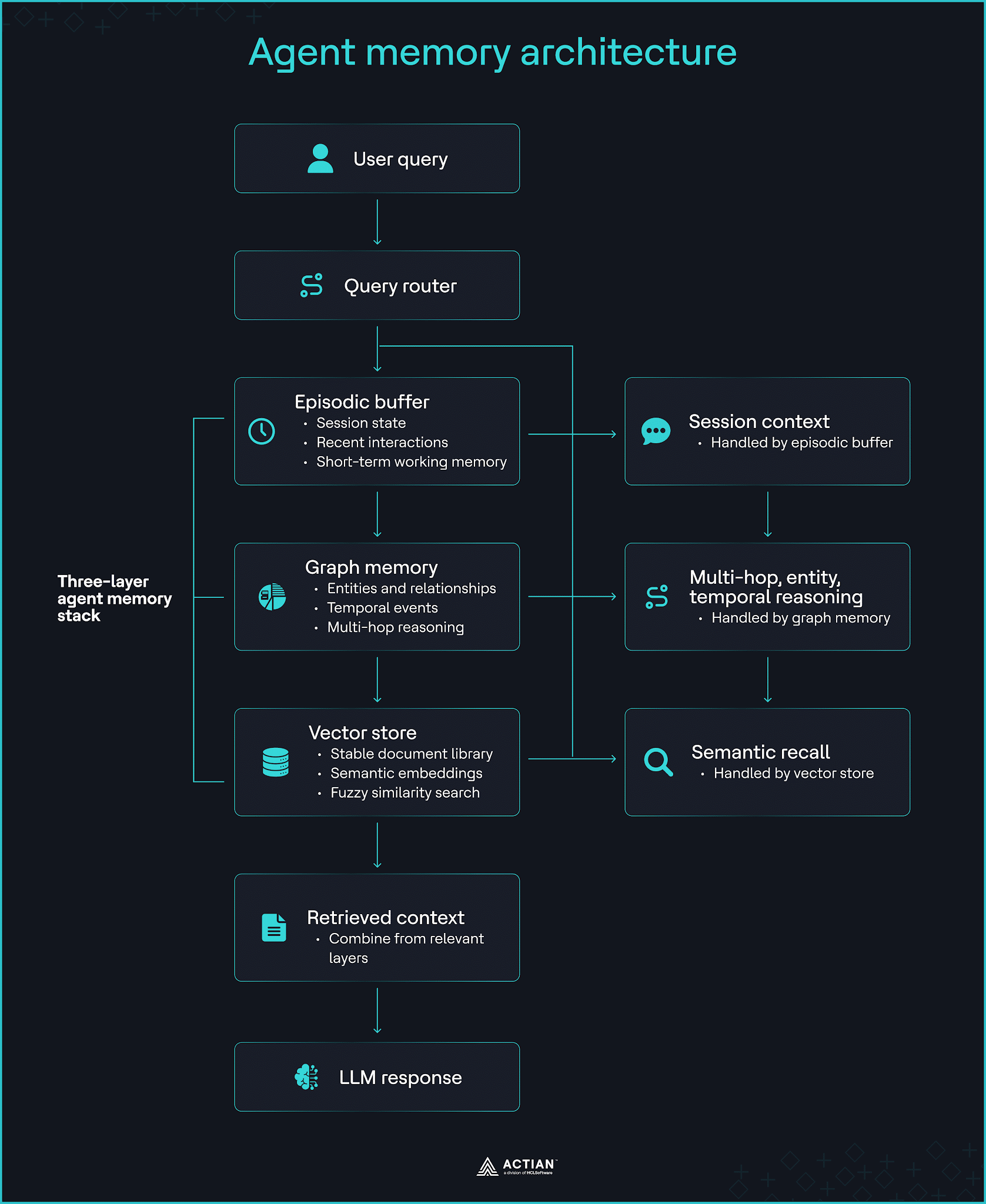
Three-layer agent memory
Coding agents and mutable working state belong on grep, but vector search is still the right infrastructure for large-scale knowledge retrieval.
The Deployment Environment the Category Forgot
Most vector database comparisons published in Q1 2026 assume persistent cloud connectivity. That assumption excludes manufacturing floors, hospital networks, air-gapped defense systems, and any environment where the data cannot leave the building. Three forces are now making that gap impossible to ignore. Our CTO, Emma McGrattan explains how the category got here: “The first wave of vector database development was driven by cloud-native AI teams (researchers, startups, hyperscaler labs) working in environments where data could move freely, and connectivity was assumed.”
Cloud repatriation for enterprise AI
86% of CIOs planned to move their AI workloads off the public cloud in 2025, driven by cloud costs, data sovereignty regulations, latency requirements, and vendor lock-in. Flexera’s 2026 State of the Cloud Report shows 23% have already completed that move. Cloud-first database vendors are following enterprises back on-premises.
Amazon launched RDS on Outposts for on-premises and co-location deployment. Oracle released database 26ai for on-premises deployment on Linux x86-64 platforms in January 2026. Each release was a direct response to enterprises pulling workloads back inside their own infrastructure boundaries. Desmond predicts that in H2 2026, “’can the vector database run in-boundary’ will stop being a checkbox and become the primary selection criterion. Cloud-native vendors cannot retrofit this; it is architectural.”
Data sovereignty
GDPR restricts personal data from leaving the European Economic Area (EEA). Data transfers outside the EEA require the European Commission’s Standard Contractual Clauses (SCCs), encryption at rest and in transit, role-based access controls, and documented transfer impact assessment.
HIPAA demands technical safeguards on electronic protected health information (PHI). The EU AI Act, coming into force on August 2nd, 2026, requires documented data governance, with fines for high-risk AI systems reaching €35M or 7% of annual global turnover. None of these laws explicitly mandates data residency, but the data must follow local laws regardless of where it resides. That is why 95% of senior executives now consider sovereign AI a mission-critical priority. Keeping data within your security perimeter is the practical path to compliance. As Emma noted, “retrofitting sovereignty and governance into systems not designed for it is expensive, slow, and often incomplete.”
Physics
Network latency is not a configuration problem. Even within the same cloud region, round-trip time adds 20–80ms before any compute begins. Add application processing time, embedding model latency, and propagation delay, and cloud vector search introduces a latency floor that no optimization removes.
As Emma stated,
A well-optimized cloud vector search returning results in 20ms is still four times too slow for industrial fault detection or autonomous vehicle scene classification. If you need sub-5ms retrieval, cloud is off the table regardless of everything else. The physics of a network round-trip don’t bend.
Asan Medical Center (AMC) deployed Korea’s first private knowledge retrieval system for sepsis treatment, running entirely on the hospital’s on-premises servers in a closed network. The system delivers sepsis diagnostic tests and antibiotic guidelines faster and keeps sensitive patient data inside the hospital boundary. AMC is a preview of the hardware constraint every edge deployment faces.
Devices with less than 4GB of storage tolerate between 10K and 1M vectors without pruning or tiering. Cloud-native engines were sized for cloud RAM budgets, and that assumption breaks on edge hardware.
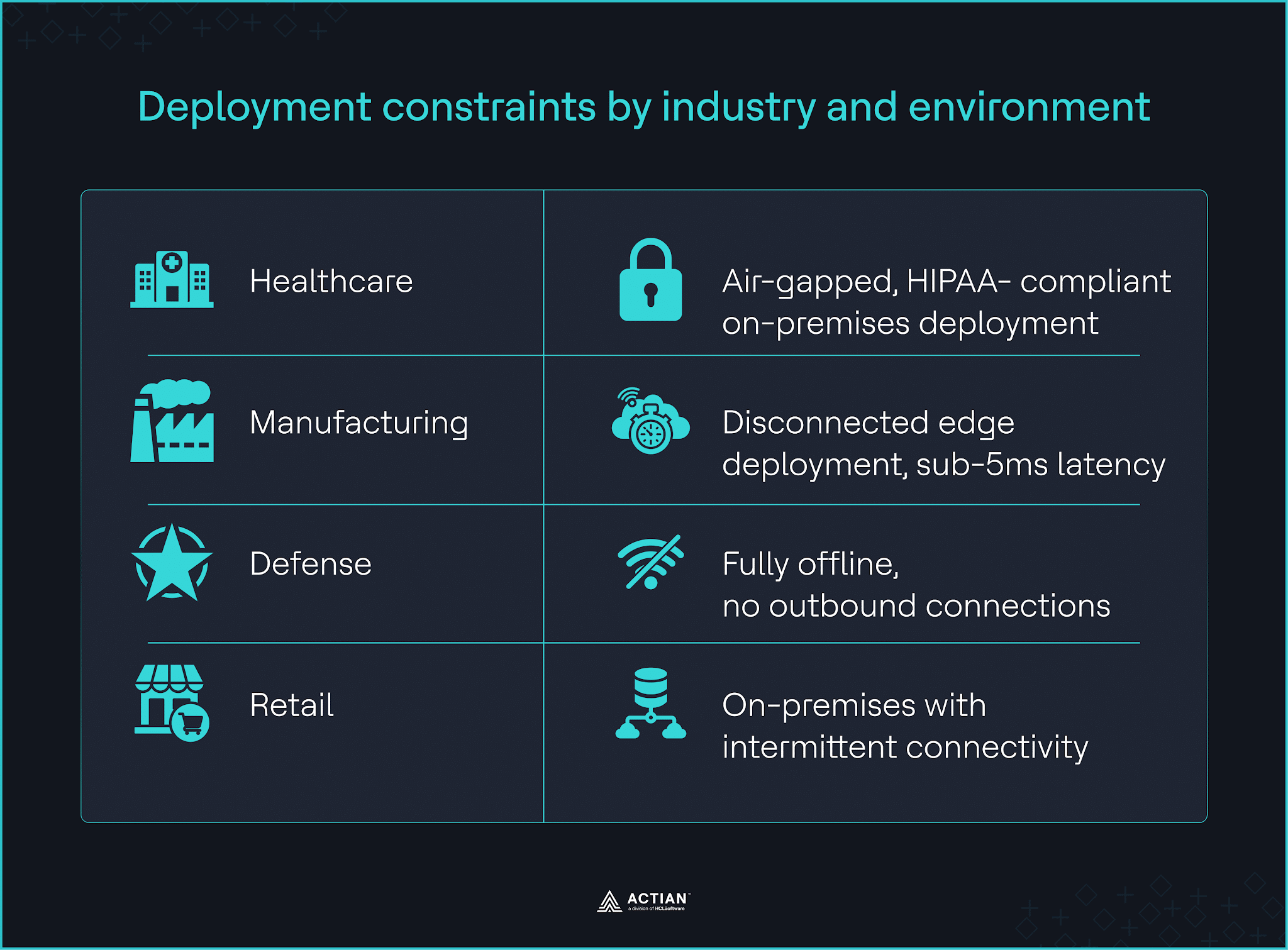
Deployment constraints by industry and environment
The table below maps these constraints across cloud, on-premises, and edge deployment models.
| Deployment model | Latency floor | Maximum vector count | Connectivity requirement | Sovereignty compliance | Operational model | Typical cost model |
| Cloud | 50–500ms | 100M+ vectors | Always required | Regional cloud options; data may cross borders | Managed SaaS; vendor handles maintenance | Usage-based; charges include query, storage, and egress fees |
| On-premises | Sub-20ms | 10–50M vectors, constrained by hardware | Intermittent connectivity | Full control; data stays on-site | Self-managed; team handles operations and hardware maintenance | Capital expenditure and operating expense |
| Edge | Sub-5ms | 10K–1M vectors; constrained by memory and hardware | Disconnected; fully offline capable | Data never leaves the device | Embedded or deployed binary; minimal ongoing maintenance | One-time license or hardware purchase |
Cloud deployment remains the lowest-friction path for 100M+ workloads that require sub-100ms latency and persistent connectivity.
Workloads with intermittent connectivity that demand sub-5ms latency and local data processing need edge or on-premises deployment. As Emma stated, “The open-source vector database ecosystem, while excellent for cloud deployments, simply doesn’t optimize for the constraints that matter at the edge: constrained memory footprints, intermittent connectivity, hardware-specific performance tuning, predictable local latency, and the ability to run entirely air-gapped.” Even vendors moving toward hybrid models have not closed that gap. Zilliz Cloud launched Bring Your Own Cloud Infrastructure (BYOC-I) in April 2025, but it still requires cloud access.
Before selecting a deployment model, answer these three questions:
- What is your connectivity model?
- Does your workload require sub-5ms latency?
- Does it have a data residency or air-gap requirement?
If any answer points away from persistent network connectivity, cloud-native vendors cannot serve your workload. Actian VectorAI DB is built exactly for network constraints. VectorAI DB runs on NVIDIA Jetson, Raspberry Pi, industrial edge servers, hospital data centers, and air-gapped facilities. It delivers 1,040 QPS at 1M vectors with p99 latency at 12.7ms on local hardware. It operates fully offline and optionally syncs when connectivity is restored.
Benchmark Trust in 2026: How to Read the Numbers
Vendor benchmarks tell you how a database performs under conditions the vendor chose to test. Before you use a number to make an infrastructure decision in Q2 2026, know what it actually measures.
Qdrant publishes the vector-db-benchmark, Weaviate owns the ANN-benchmarks, Zilliz Cloud owns VDBBench, TigerData published its pgvectorscale benchmark using a fork of the ANN-benchmarks, and Redis publishes its own benchmark suites.
Most benchmarks test pre-built indexes, static datasets, and outdated database configurations. None of those conditions mimic production setups and agent workloads. Qdrant’s benchmark page explicitly states: “Are we biased? Probably, yes.” In a LinkedIn post critiquing TigerData’s benchmark results, Qdrant added, “No one publishes a benchmark where their product doesn’t shine. We do the same.”
TigerData’s pgvectorscale vs. Qdrant benchmark ran the Cohere Wikipedia 50M (768-dim) dataset with a 99% recall target on an AWS r6id.4xlarge instance. The setup used 16 vCPUs, 128GB RAM, and a 950GB locally attached NVMe SSD. Under sub-100ms query latencies, pgvectorscale returned 471.57 QPS against Qdrant’s 41.47 QPS. Qdrant won on index build time at 3.3 hours against pgvectorscale’s 11.1 hours, and on tail latency at 90% recall, achieving 58.6% lower p95 latency and 63.2% lower p99 latency.
Qdrant argued the test did not reflect production use cases involving metadata filters, hybrid search with sparse vectors, or multi-vector search. They also stated that TigerData did not optimize Qdrant for its own architecture, whereas pgvectorscale used StreamingDiskANN and Statistical Binary Quantization (SBQ). The throughput gap narrows when either condition changes.
Qdrant’s critique identifies exactly what most vector database benchmarks skip. VDBBench 1.0 by Zilliz Cloud tests continuous data ingestion, search throughput, performance drift under concurrent read/write loads, and metadata filter selectivity. Those are the conditions your production system will face.
Every benchmark number you use should answer these five questions first:
- Who published the benchmark?
- What hardware, index parameter, and concurrency configuration did the benchmark run on?
- What metrics were chosen and what was excluded?
- Does the workload match your use case?
- Is the benchmark reproducible and independently verified?
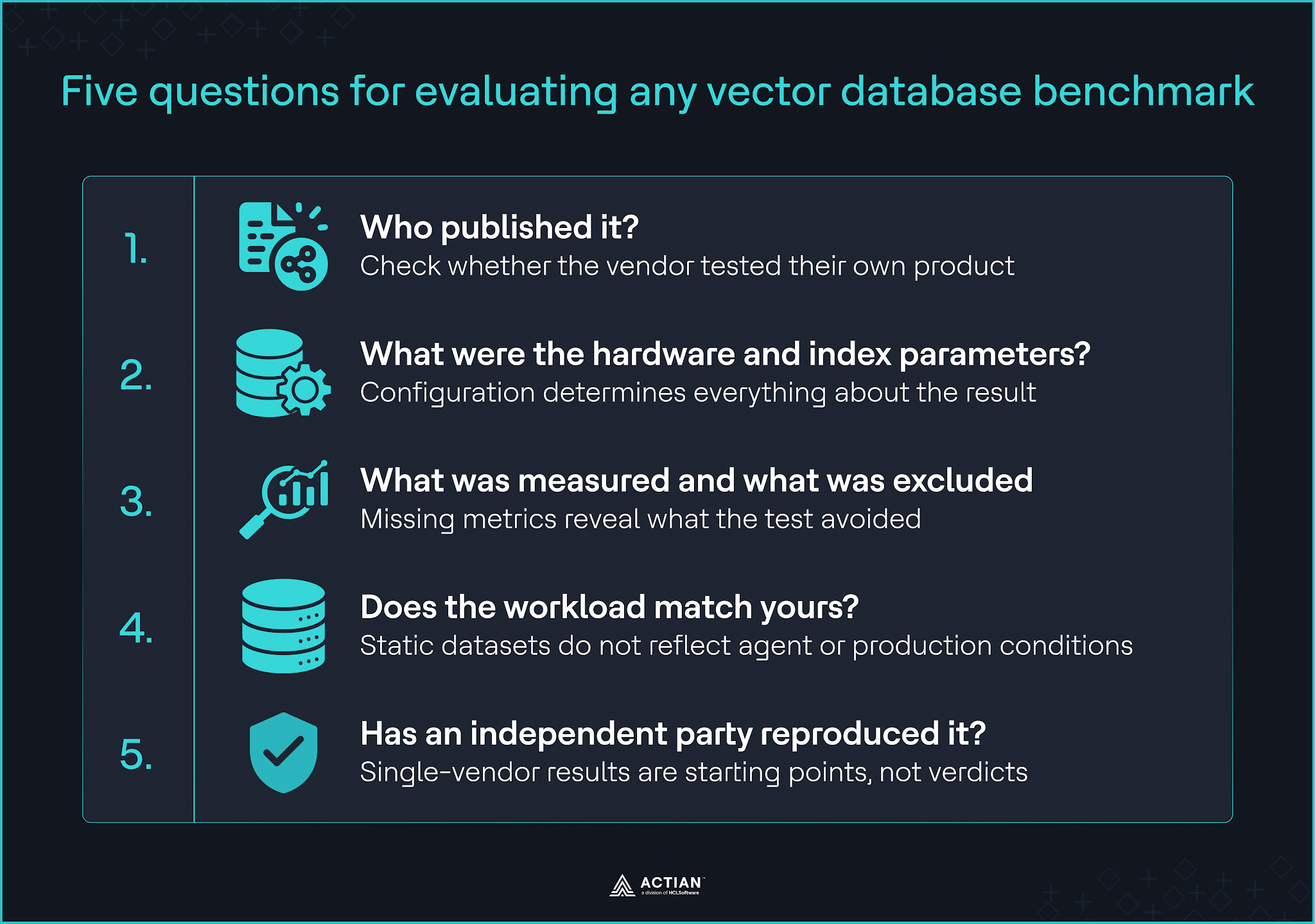
Five questions for evaluating any vector database benchmark
As Desmond puts it, “If recall, hardware, and concurrency are not all stated, discard the number”. The most reliable benchmark is the one you run on your data, hardware, and query patterns. If your team runs vector workloads on Milvus, patch to version 2.5.27+ or 2.6.10+ before comparing any benchmark results. It addresses the CVE-2026-26190 (CVSS 9.8) and CVE-2025-64513 (CVSS 9.3) authentication vulnerabilities.
The Community Mindshare Map
The vector database market has settled into clear patterns of adoption, pricing, and use-case fit in Q2 2026.
Milvus leads open-source community interest with 44,000+ GitHub stars, followed by Qdrant at 32,000+, ChromaDB at 28,000+, Weaviate at 16,000+, and LanceDB at 10,000+.
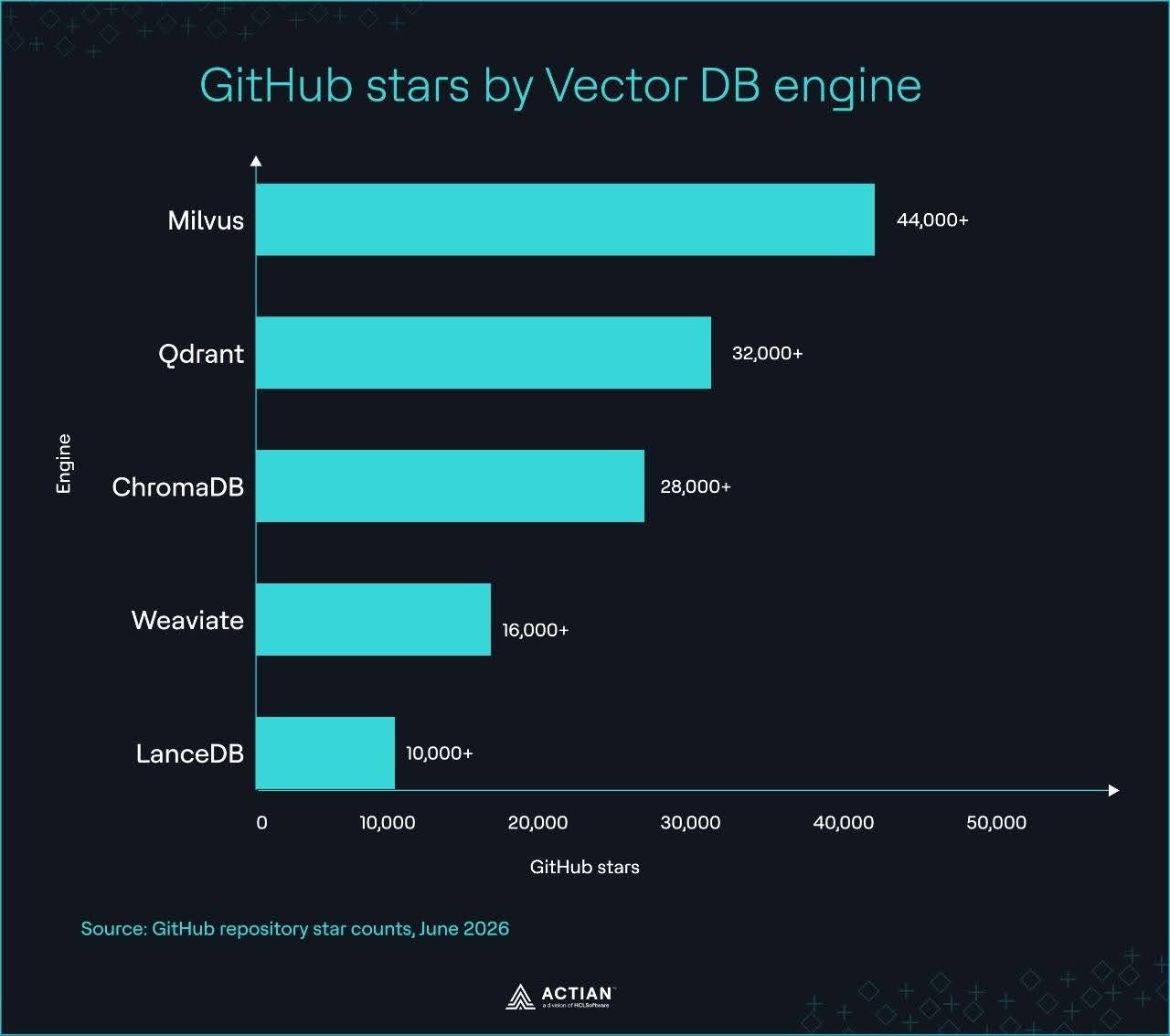
Star count reflects community interest, not production usage
LanceDB has the steepest mindshare growth rate, rising from 6.7% to 9.6% year-over-year after raising a $30M Series A in June 2025. ChromaDB dropped from 15.6% to 13.4% over the same period as pgvector absorbed attention from teams already running Postgres.
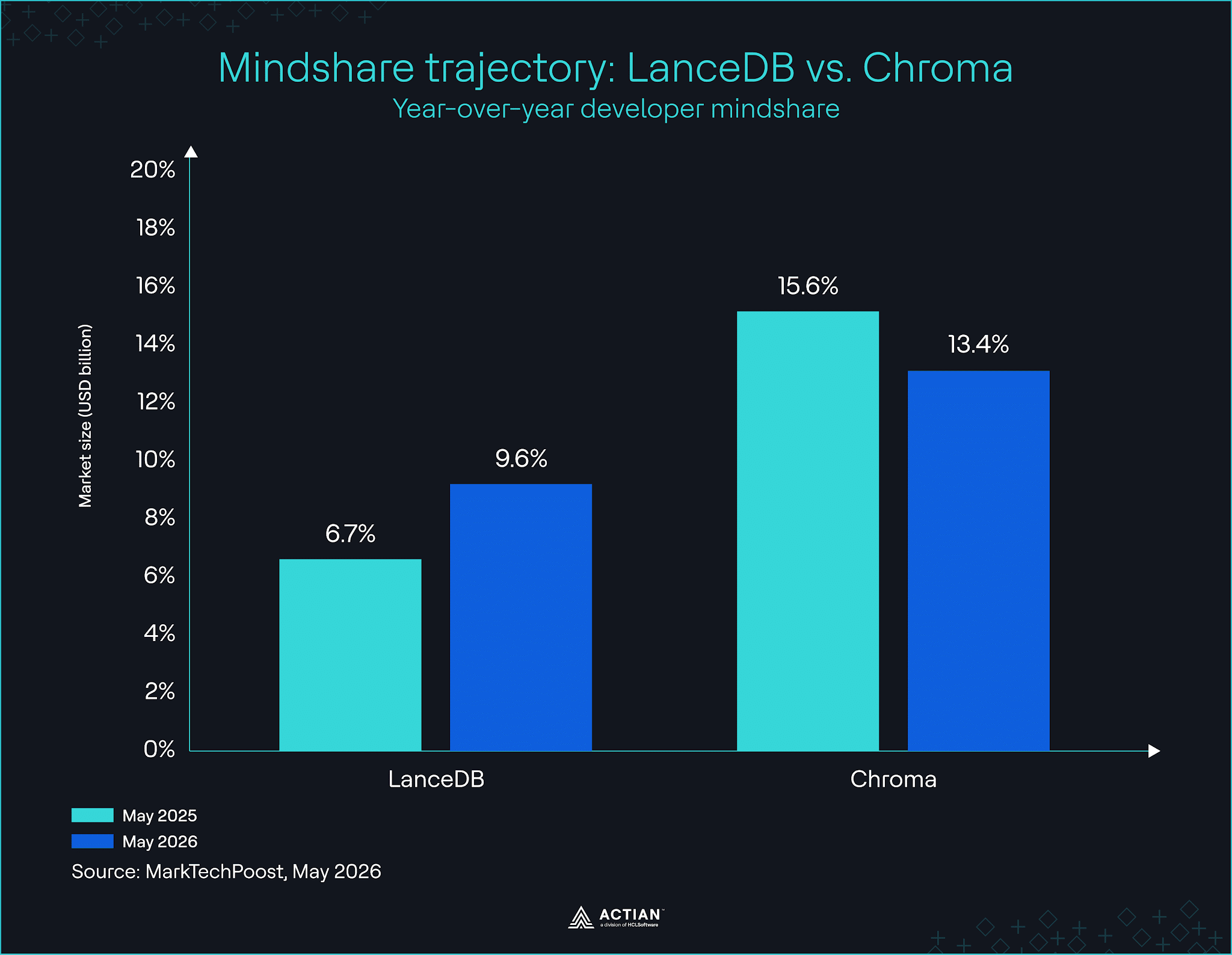
LanceDB vs. Chroma mindshare trajectory
Weaviate, Milvus, Qdrant, and LanceDB are free to self-host. You pay only for the compute you run them on. Their managed tiers are where the cost picture diverges.
Weaviate Cloud replaced its $25/month Serverless plan with a $45/month Flex plan on October 27th, 2025, an 80% increase. The Plus plan costs $280/month, and the Premium plan costs $400/month. Each tier adds usage-based fees covering vector dimensions, storage, and backup retention.
Zilliz Cloud offers a free tier with five collections, 5GB storage, and 2.5M vCUs per month. The Dedicated Standard plan runs $126 per month in compute costs. The Dedicated Enterprise plan runs $196.56 per month, with storage at $0.025/GB and data transfer fees billed separately.
Qdrant Cloud’s free tier includes a single-node cluster with 1GB RAM, 0.5 vCPU, and 4GB disk. The Standard tier charges for compute, memory consumption, backup storage, and model inference tokens. The premium tier requires a direct sales conversation. LanceDB Cloud prices object storage at $0.02 per GB per month, with Enterprise pricing on a custom annual commitment.
Pinecone introduced a $20 per month Builder tier on May 6th, 2026, after launching a $50/month Standard tier in July 2025. OpenMetal documented that the $50 starting price scaled to $380 and then $2,847 as usage grew. The Enterprise plan carries a $500 monthly minimum charge as of June 2026.
The use-case consensus of the top vector databases in 2026 maps to scale and operational preference. Pinecone removes operational overhead for teams that want managed infrastructure. pgvector serves Postgres teams with 10–50M vectors. Milvus handles distributed query and shard management for billion-scale deployment. Weaviate suits applications that need native hybrid search and integrated embedding models. Qdrant provides composable vector search and JSON-based filters. ChromaDB covers RAG prototypes and local internal tooling. LanceDB is well-suited for embedded applications and multimodal AI systems.
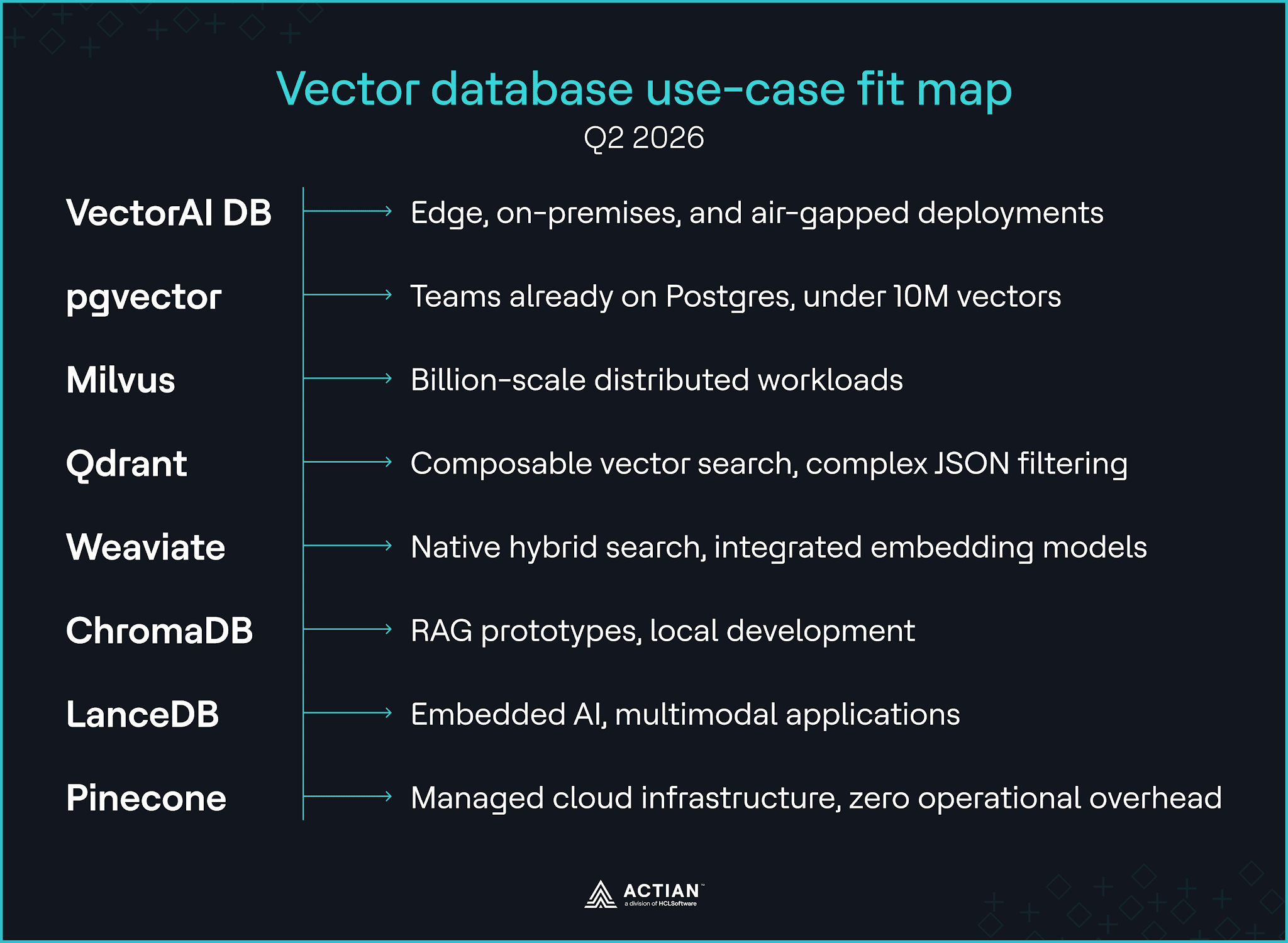
Vector database use case fit map for Q2 2026
The Decision Framework for This Quarter
These three audits determine which vector database fits your stack. Run them in order before choosing any infrastructure for your application or agent.
Audit 1: Vector count
Your vector count sets the boundaries of what is worth evaluating.
- <10M vectors on Postgres: Use pgvector. It keeps vector data adjacent to relational data without managing a new database engine. You get ACID transactions, hybrid search, and one security model in the same system.
- 10M–50M vectors: Compare the performance of self-hosted Qdrant and pgvectorscale on your data before committing. Qdrant delivers vector search with payload-based JSON filtering. pgvectorscale improves pgvector’s performance at medium scale with StreamingDiskANN.
- >50M or multi-tenancy at agent scale: Use Milvus’ distributed and GPU-accelerated architecture to scale horizontally or build a custom vector store modeled on your agent’s behavior.
Audit 2: Deployment constraint
Where your application runs determines which databases remain viable. If your workload requires:
- Sub-5ms latency: Eliminate Pinecone. A client-server architecture on edge devices or disconnected environments will struggle to meet that response time. Localize the embedding process, and prioritize databases that run on-device and on-premises. Test whether they meet the memory budget on your hardware.
- Air-gap compliance: Eliminate managed cloud databases. They require network access and remote license validation. Use self-hosted databases like VectorAI DB and Qdrant. Qdrant’s Rust-written binary is lightweight, and its Docker image exports as a .tar archive. VectorAI DB is built for vector workloads in air-gapped deployment.
- Strict data residency: Audit your entire data lifecycle. Confirm where customer data, telemetry, and system logs sit at rest, where they move in transit, and where backups reside. Verify that the cloud database provider operates physically isolated data centers inside your residency boundary. Prioritize local databases like Weaviate and VectorAI DB that run via Docker to maintain full data control. Both databases support multi-tenancy for data residency compliance.
Audit 3: Workload type
Your retrieval pattern determines which index architecture fits.
- One-shot retrieval: Use HNSW-supported vector stores for RAG, semantic search, and recommendation systems. They are optimized for top-K recall accuracy and low read latency.
- Write-heavy agent memory with under 10M vectors: Use Postgres with pgvector. pgvector’s IVFFlat index builds and updates indexes faster with minimal CPU overhead, and Postgres writes new vector embeddings to a Write Ahead Log (WAL) so agents do not lose track of active conversation context. Integrate Mem0 to handle semantic compression and memory movement between the agent’s short-term context and Postgres.
- Write-heavy agent memory above 10M vectors: Large-scale agentic workloads need high write throughput without index rebuild pauses. Use Milvus’ streaming indexing to write vectors continuously, while its background compaction merges data segments automatically to maintain query performance.
The flowchart below collapses all three audits into a decision path you can follow against your own stack.
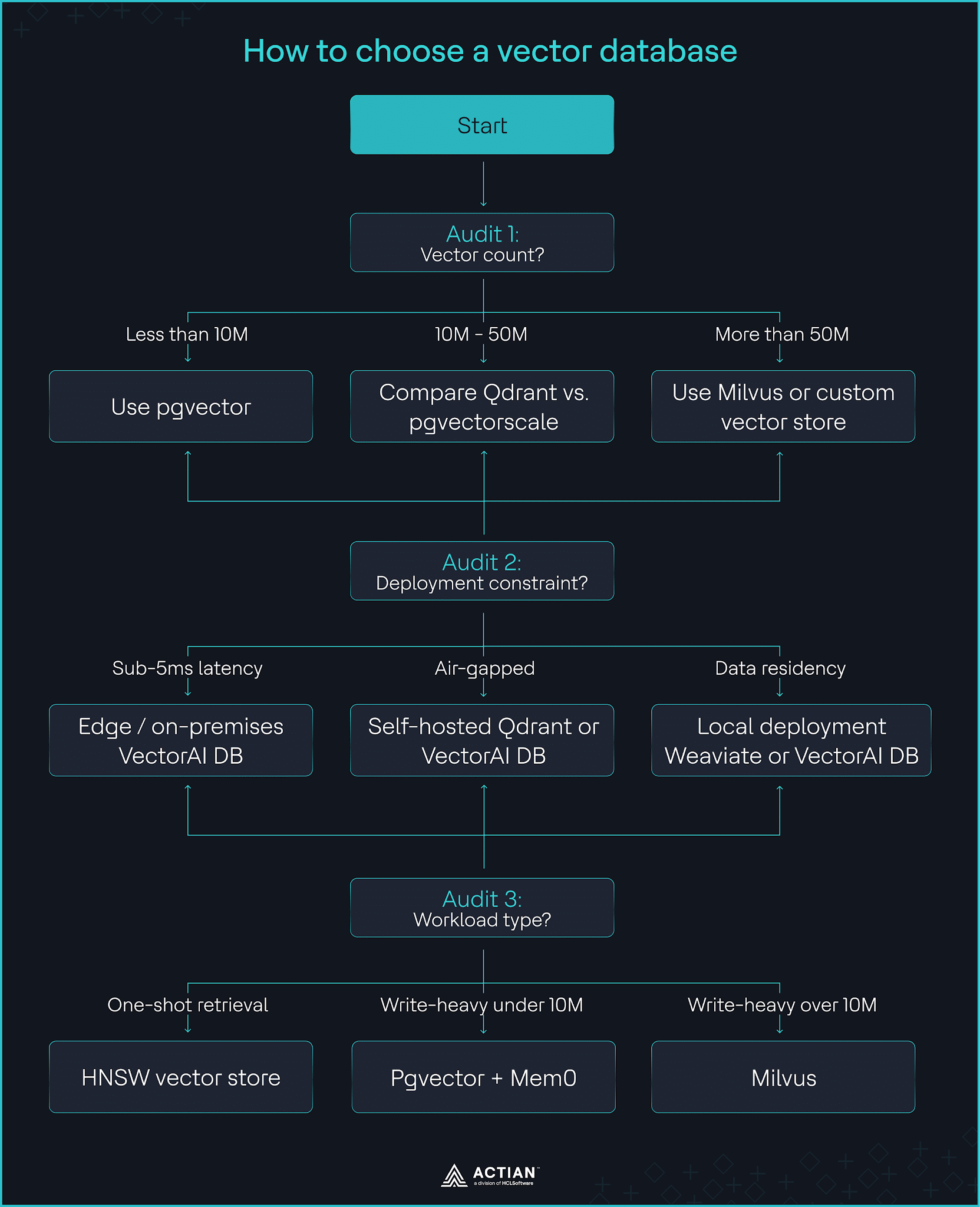
Decision flowchart for choosing vector databases in 2026
Before any migration, do these three things:
- Run VDBBench 1.0 against your own workload and hardware.
- Document your embedding pipeline if your workload runs on Pinecone.
- Patch to versions 2.5.27+ or 2.6.10+ before any architectural changes on Milvus.
Wrapping Up
The vector database category is not dying. The scale segment below 50M vectors is consolidating around Postgres. Above that threshold, purpose-built engines still own the performance and operational envelope that general-purpose databases cannot match.
Agents are forcing a retrieval architecture review that no vendor has fully solved yet. The workloads that cannot send data to a cloud server remain the least-addressed problem in the category.
The decision you make this quarter does not need to wait for the market to settle. Your vector count, deployment constraint, and retrieval pattern already point to an answer. Run the three audits and act on what they show.
If your audits show edge, on-premises, or air-gapped deployment, that is the segment most cloud-native vendors cannot serve with their current architecture. VectorAI DB is designed for those constraints. See what developers have already built with it across healthcare and manufacturing.

Stay connected
Data insights delivered to you.
(i.e. sales@..., support@...)
